

A scientific breakthrough that could challenge one of humanity’s oldest symbols of wealth
What if the gold we wear, save and invest in today could one day be manufactured using nuclear fusion?
For thousands of years, gold has represented wealth, power, beauty and financial security. Civilisations have fought wars over it, explorers have travelled continents searching for it, and investors have relied on it as a store of value during times of uncertainty.
But a remarkable development in nuclear science has raised a question that sounds straight out of science fiction: What if humanity no longer had to depend entirely on gold mines to obtain gold?
Enter Marathon Fusion, a US-based nuclear fusion startup that has announced a potentially extraordinary achievement: converting mercury into stable gold using fusion-generated neutrons.
The claim, announced on October 21, 2026, has reignited the ancient dream of alchemy—the transformation of one element into another. More importantly, it has sparked a modern economic debate: if scientists eventually learn to produce gold economically at an industrial scale, could the technology change the global gold market forever?
The answer depends on how far this technology can advance.
1. The Science Behind Turning Mercury into Gold
At first glance, turning mercury into gold sounds impossible. However, modern nuclear physics tells a different story.
Every chemical element is defined by the number of protons in its atomic nucleus. Gold has 79 protons, while mercury has 80. If a nuclear reaction changes the nucleus in the right way, one element can become another.
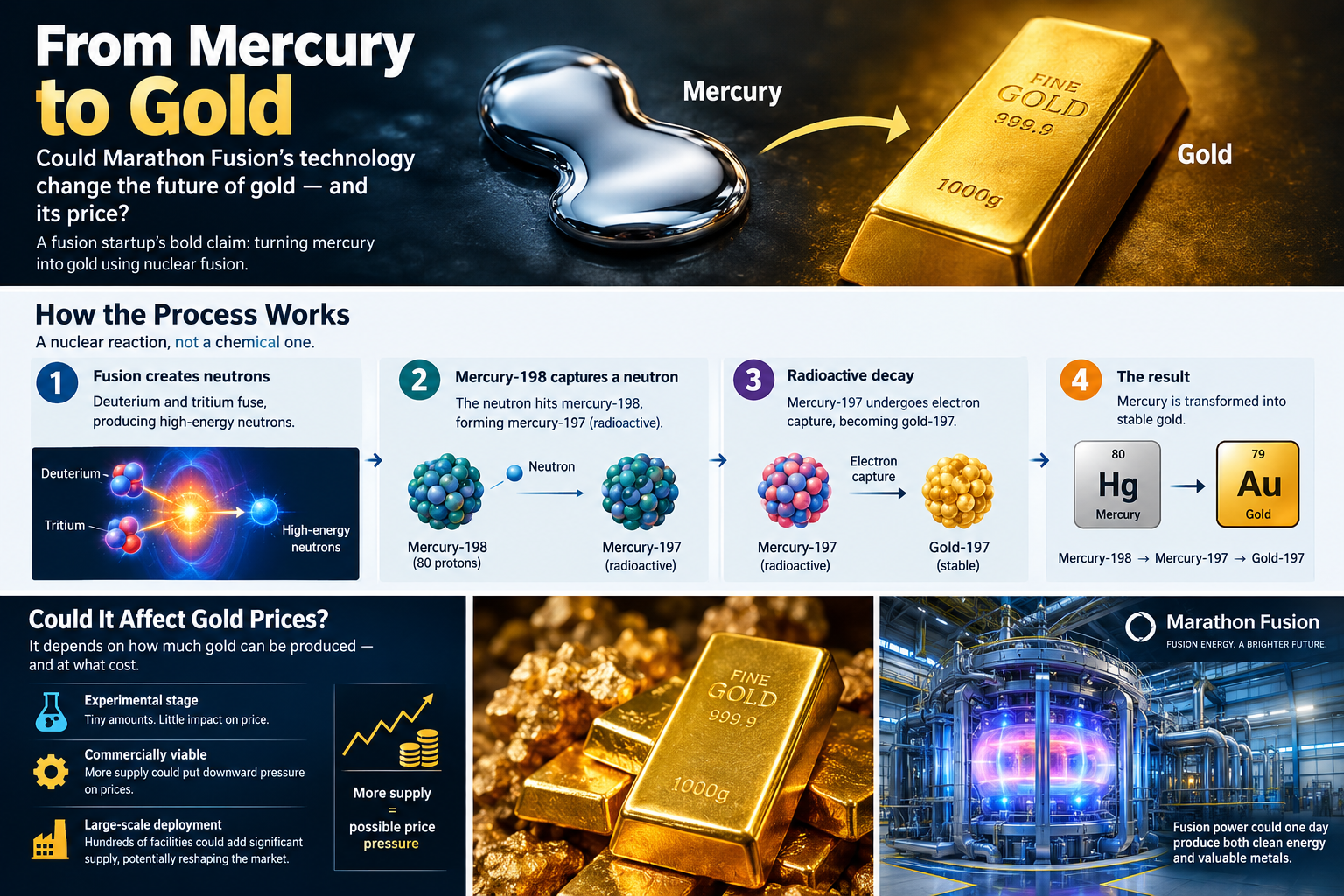
Marathon Fusion’s proposed process uses a specific isotope of mercury known as mercury-198.
The process involves three main stages:
Stage 1: Generating high-energy neutrons
A deuterium-tritium fusion reaction releases high-energy neutrons. These neutrons can interact with the nuclei of other elements.
Stage 2: Transforming mercury
When mercury-198 captures a neutron and undergoes the appropriate nuclear reaction, it can form mercury-197, an unstable radioactive isotope.
Stage 3: Producing gold
Mercury-197 subsequently undergoes radioactive decay through electron capture, producing gold-197—the stable isotope of gold found in nature.
In simplified form:
Mercury-198 → Mercury-197 → Gold-197
This is known as nuclear transmutation. It is fundamentally different from ordinary chemical manufacturing because it changes the identity of the atomic nucleus itself.
The underlying physics is established science. What remains to be established independently is the scale, efficiency and commercial potential of Marathon Fusion’s latest reported achievement.
2. Has Marathon Fusion Really Made Gold?
Marathon Fusion says it has successfully demonstrated the conversion of mercury into stable gold and claims its production rate exceeded a benchmark associated with CERN by a factor of ten.
That is an exciting claim, but scientific evidence matters more than headlines.
As of October 24, 2026, the company has not publicly disclosed enough information to independently establish the amount of gold produced, the full experimental methodology or the cost of production.
For context, CERN researchers previously estimated that experiments at the Large Hadron Collider produced approximately 29 picograms of gold nuclei during operations between 2015 and 2018. That quantity was extraordinarily small, and the nuclei did not survive as usable gold.
Marathon Fusion’s approach is different: it aims to use fusion-generated neutrons to produce gold through nuclear reactions.
The distinction is important. Producing detectable gold in an experiment is one achievement. Producing grams, kilograms or tonnes of commercially usable gold is an entirely different challenge.
Nevertheless, if Marathon Fusion’s claims withstand independent testing, the development could represent an important step towards practical nuclear transmutation.
Sources: NDTV’s report on Marathon Fusion and The Economic Times’ analysis.
3. The Big Question: Could Gold Become Cheap?
This is where the story moves beyond science and into economics.
Today, most newly mined gold must be discovered, extracted from ore, processed and refined. Mining can be expensive, energy-intensive and environmentally challenging.
Gold is also scarce. Its price reflects not only the cost of producing it but also its desirability, investment demand, central-bank purchases, jewellery consumption and role as a financial safe haven.
A technology that could manufacture gold at a competitive cost would introduce a new source of supply.
However, the effect on prices would depend on how much gold could be produced and how cheaply.
Scenario A: The technology remains experimental
If nuclear transmutation continues to produce only tiny quantities of gold, the effect on the global gold market would be practically negligible.
Gold prices would continue to be driven by conventional market forces, including interest rates, inflation expectations, currency movements, geopolitical uncertainty and investment demand.
In this scenario, the scientific achievement could be enormous while its economic impact remains close to zero.
Scenario B: Gold production becomes commercially viable
Suppose future fusion facilities can produce gold in meaningful quantities at a cost competitive with mining.
Additional supply could put downward pressure on gold prices, particularly if production expands faster than demand.
Mining companies might face greater competition. Investors could begin reassessing gold’s long-term scarcity. Jewellery manufacturers might eventually gain access to another source of supply.
However, lower production costs would not automatically translate into a dramatic fall in gold prices. The amount of gold entering the market would still matter.
Scenario C: Artificial gold production expands worldwide
Imagine a future in which fusion power plants become commercially successful and gold production becomes a profitable byproduct of operating them.
If hundreds of facilities eventually produced substantial quantities of gold every year, the additional supply could become significant.
At that point, the market might face a fundamental question: if gold can be manufactured at scale, how much of its value should still come from its natural scarcity?
This is the scenario that could potentially transform the gold industry.
But it remains a hypothetical future, not an established commercial reality.
4. The Numbers: How Much Gold Could Fusion Technology Produce?
To understand the potential impact, consider the size of today’s gold market.
According to the World Gold Council, global mine production reached approximately 3,672 tonnes in 2025. Total gold supply, including recycled gold and other sources, was approximately 5,002 tonnes.
Marathon Fusion’s earlier research proposed that a future fusion power plant could potentially produce around two tonnes of gold annually per gigawatt of thermal power under its modelled assumptions.
That figure is a projection, not a demonstrated production rate.
Consider the following illustrative scenarios:
Hypothetical future deployment
Annual gold production
Approximate share of 2025 mine production
1 facility producing 2 tonnes
2 tonnes
0.05%
10 facilities
20 tonnes
0.54%
50 facilities
100 tonnes
2.72%
100 facilities
200 tonnes
5.45%
500 facilities
1,000 tonnes
27.2%
These are illustrative calculations based on an assumed output of two tonnes per facility per year. They are not forecasts of actual production, and they assume every facility achieves that output. The original research describes a gigawatt of thermal power, which should not be confused with a gigawatt of electrical generating capacity.
The numbers reveal an important point.
One facility producing a few tonnes of gold annually would be unlikely to transform the global market by itself. But a mature industry operating hundreds of such facilities could introduce a meaningful amount of additional supply.
Even then, the effect on prices would depend on production costs, deployment speed, recycling, demand growth and the quantity of gold actually reaching the market.
Source: World Gold Council — Gold Demand Trends, Full Year 2025.
5. Could Gold Prices Crash Like Lab-Grown Diamonds?
The comparison with lab-grown diamonds is tempting.
Technological advances in diamond production expanded the supply of laboratory-created stones and contributed to significant price declines in that segment of the market.
Could artificially produced gold follow the same path?
Possibly, but there is a fundamental difference.
Lab-grown diamonds are made by arranging carbon atoms into the diamond structure. Nuclear transmutation requires changing atomic nuclei, which is considerably more demanding.
Gold production through fusion would involve advanced reactors, neutron management, specialised materials, radioactive byproducts and potentially expensive processing.
The economics must work before large-scale production becomes possible.
There is also a difference in how the products compete. Laboratory-created diamonds can serve many of the same jewellery purposes as mined diamonds. Nuclear-produced gold, if successfully manufactured and purified, would be chemically the same element as naturally mined gold.
That means the gold market could eventually have difficulty distinguishing between the two on chemical identity alone. Provenance, certification and production history could still matter to particular buyers.
But the decisive question would remain: Can manufactured gold be produced cheaply enough, and in sufficient quantities, to compete with existing supply?
Until that question is answered, predictions of a gold-price collapse are premature.
6. What Would This Mean for Gold Investors in India?
For Indian investors, the implications deserve attention because gold plays an important role in jewellery purchases, household savings and investment portfolios.
If fusion-made gold eventually becomes commercially viable, the impact could reach several parts of the Indian gold market.
Jewellery buyers: A sustained reduction in the underlying price of gold could make jewellery more affordable. However, making charges, taxes, import costs and retail margins would continue to affect the final price.
Gold investors: Investors might need to pay closer attention to long-term changes in gold supply. Nevertheless, a future technological possibility should not be confused with a current reason to expect falling prices.
Gold traders: A confirmed breakthrough could affect sentiment, especially if markets begin anticipating a future increase in supply. The immediate reaction, if any, would depend on the credibility and commercial significance of the evidence.
Gold mining companies: If manufactured gold eventually becomes cheaper than mined gold and production expands substantially, mining businesses could face increased competitive pressure.
One crucial point: Indian gold prices do not depend solely on global gold supply. International gold prices, the rupee-dollar exchange rate, import duties, taxes and domestic demand also play significant roles.
Therefore, even if this technology eventually affects international prices, the precise impact on Indian retail prices would depend on several additional factors.
7. Why Gold May Remain Valuable Even If Scientists Can Manufacture It
Gold’s value is not based exclusively on its scarcity.
It has distinctive chemical properties, resists corrosion, is highly workable and is used in jewellery, electronics and other specialised applications.
It also has a long-established role as an investment asset and a reserve holding for central banks.
If manufactured gold became abundant and inexpensive, some of the value associated with scarcity could diminish. Yet other sources of demand would remain.
Furthermore, gold is an existing, durable stock of wealth. Much of the gold mined throughout history remains in circulation or in storage and can potentially return to the market through recycling.
This means a new production technology would have to compete not just with newly mined gold but also with an enormous existing supply.
The market would not automatically collapse simply because another way of producing gold had been discovered.
8. The Biggest Obstacles Still Ahead
Before fusion-made gold can challenge traditional mining, several hurdles must be overcome.
First, independent verification: The company’s reported experiment needs sufficient public evidence and independent scientific scrutiny.
Second, commercial-scale fusion: The technology depends on fusion systems capable of operating reliably and economically. Demonstrating a nuclear reaction does not establish that a commercial fusion power plant is viable.
Third, production economics: Mercury preparation, neutron exposure, processing, energy costs and equipment maintenance must all be considered.
Fourth, radioactive byproducts: The process can create radioactive materials. Their identification, separation, handling and safe management are essential.
Fifth, market scale: Production must reach a meaningful volume before it can exert substantial pressure on the global gold market.
These are not minor details. They are the difference between an impressive scientific experiment and an economically transformative industry.
Conclusion: Is This the Beginning of the End for Expensive Gold?
Marathon Fusion’s announcement presents a fascinating possibility: a future in which gold production is no longer exclusively dependent on geological deposits.
The science of nuclear transmutation is real, and the company’s reported achievement deserves serious examination. But independent verification, reliable commercial fusion and economical large-scale production remain essential milestones.
For now, there is no sound basis for concluding that gold prices are about to collapse because of this technology.
In the short term, gold prices will continue to depend primarily on familiar forces such as investment demand, interest rates, central-bank activity, currency movements and geopolitical developments.
Over the longer term, however, successful and economical nuclear transmutation could change how investors think about gold’s scarcity.
The most important question is no longer simply whether scientists can turn mercury into gold.
It is whether they can do so cheaply, safely, reliably and at a scale large enough to change the economics of the world’s gold supply.
If that day arrives, the consequences could extend far beyond laboratories. They could reshape mining, jewellery, investment and our understanding of what makes gold valuable.
The dream of the alchemists may be entering a new scientific chapter—but whether it becomes an economic revolution remains to be seen.
Leave a Reply